FIFA World Cup 2026 Location and Viewing Guide
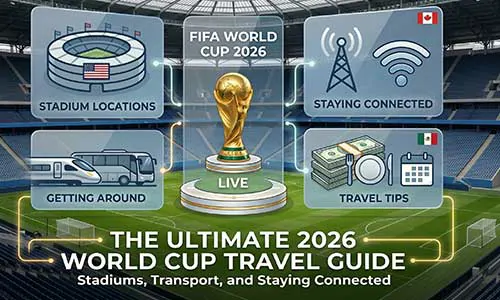
The global sports landscape is preparing for an unprecedented spectacle in 2026. For the first time in history, three nations—the United States, Canada, and Mexico—will joint-host the most prestigious football tournament on earth. With the expansion of the tournament format to include 48 teams playing 104 matches, planning your tournament journey requires detailed preparation. To help you prepare for this monumental event, this comprehensive FIFA World Cup 2026 Location and Viewing Guide offers all the crucial details you need, whether you plan to travel to the stadiums or watch live from the comfort of your home.
In this guide, we break down the host cities, stadium details, broadcast networks, streaming platforms, travel logistics, and scheduling. Consequently, you will have a clear roadmap to navigate this historic event from start to finish.
Table of Contents
- 1. The Historic Tri-Nation Host Format
- 2. Detailed Host Cities and Stadiums
- 3. Tournament Schedule and Key Dates
- 4. Navigating the Map: FIFA World Cup 2026 Location and Viewing Guide
- 5. Complete Broadcast and Live Streaming Guide
- 6. Travel and Accommodation Tips
- 7. How to Use Our FIFA World Cup 2026 Location and Viewing Guide
- 8. Final Thoughts and Next Steps
- 9. Frequently Asked Questions (FAQs)
The Historic Tri-Nation Host Format
The 2026 tournament marks the first time that three countries have collaborated to host a FIFA World Cup. While the 2002 edition featured co-hosts South Korea and Japan, the scale of the 2026 event is considerably larger. Specifically, matches will be distributed across North America, covering vast distances and distinct time zones.
Because of this massive geographic footprint, FIFA has organized the tournament into three regional clusters: West, Central, and East. This division aims to minimize travel times for players and spectators during the group stage. Consequently, teams will play their initial matches within a specific region, reducing exhaustion and travel expenses.
Furthermore, the expansion to 48 teams means more matches, more host venues, and more opportunities for fans to witness the action live. A total of 104 matches will take place over 39 days, making this the longest and largest World Cup tournament to date.
Detailed Host Cities and Stadiums
A total of 16 cities across the United States, Mexico, and Canada will host matches. Eleven venues are located in the United States, three in Mexico, and two in Canada. Each stadium brings its own unique character, history, and state-of-the-art facilities to the tournament.
Below is a detailed breakdown of the host cities, organized by their respective regional clusters:
The West Region
- Vancouver, Canada: BC Place. This iconic venue with a retractable roof will bring the coastal atmosphere of British Columbia to the tournament.
- Seattle, USA: Lumen Field. Known for its intense crowd noise and passionate soccer culture, this stadium promises an electric atmosphere.
- San Francisco Bay Area, USA: Levi’s Stadium. Located in Santa Clara, this highly technological venue is situated in the heart of Silicon Valley.
- Los Angeles, USA: SoFi Stadium. A modern architectural masterpiece in Inglewood, designed to host major global entertainment events.
- Guadalajara, Mexico: Estadio Akron. Home to CD Guadalajara, this modern stadium is famous for its unique exterior design that resembles a volcano.
The Central Region
- Kansas City, USA: GEHA Field at Arrowhead Stadium. Famous for its loud atmosphere and deep sports traditions in America’s heartland.
- Dallas, USA: AT&T Stadium. A colossal indoor stadium in Arlington, Texas, featuring a massive central video screen and a retractable roof.
- Houston, USA: NRG Stadium. A versatile, fully air-conditioned venue with a retractable roof, ideal for the warm summer months.
- Atlanta, USA: Mercedes-Benz Stadium. An award-winning stadium with a retractable roof and a unique 360-degree halo board.
- Monterrey, Mexico: Estadio BBVA. Often called “The Steel Giant,” this stadium offers a stunning backdrop of the Cumbres de Monterrey national park.
- Mexico City, Mexico: Estadio Azteca. A legendary football cathedral that will become the first stadium to host matches in three different World Cups (1970, 1986, and 2026).
The East Region
- Toronto, Canada: BMO Field. This venue is undergoing major expansions to increase its capacity for the global audience.
- Boston, USA: Gillette Stadium. Located in Foxborough, Massachusetts, this venue has a rich history of hosting international soccer matches.
- New York/New Jersey, USA: MetLife Stadium. Located in East Rutherford, New Jersey, this massive open-air venue is scheduled to host the tournament final.
- Philadelphia, USA: Lincoln Financial Field. A modern, open-air stadium known for its passionate sports fan base.
- Miami, USA: Hard Rock Stadium. A dynamic, multi-purpose stadium that regularly hosts major tennis tournaments, Formula 1, and global soccer matches.
To help you compare the sizes and locations of these iconic arenas, we have compiled a summary table below:
| Host City | Stadium Name | Country | Approx. Capacity |
|---|---|---|---|
| Mexico City | Estadio Azteca | Mexico | 87,500 |
| Dallas (Arlington) | AT&T Stadium | USA | 80,000 |
| New York/New Jersey | MetLife Stadium | USA | 82,500 |
| Atlanta | Mercedes-Benz Stadium | USA | 71,000 |
| Vancouver | BC Place | Canada | 54,500 |
| Toronto | BMO Field | Canada | 45,000 |
Tournament Schedule and Key Dates
The tournament is scheduled to begin in mid-June 2026. The opening match will take place at the iconic Estadio Azteca in Mexico City, setting a vibrant tone for the rest of the matches. Over the next month, matches will transition from the group stages to the intense knockout phases.
Because there are 12 groups of four teams, the top two teams from each group, along with the eight best third-place finishers, will advance to the newly introduced Round of 32. This additional round increases the level of drama and provides fans with more high-stakes matches.
The semi-finals are scheduled to be held in major US cities with high-capacity indoor stadiums to protect teams and fans from summer heat. Ultimately, the grand final will take place on July 19, 2026, crowning the world champion in front of a global audience of billions.
Navigating the Map: FIFA World Cup 2026 Location and Viewing Guide
Navigating the vast distances between host cities is one of the primary challenges for fans planning to attend live matches. Moving from Vancouver in the northwest to Miami in the southeast requires significant travel time. Consequently, understanding regional transport options is vital.
Travelers should focus on flight booking networks and local public transit within host cities. Most venues are connected to metropolitan areas via light rail, dedicated shuttles, or major highways. For instance, cities like New York and Atlanta have extensive public subway systems that lead directly to, or near, the stadium gates.
Furthermore, staying updated on regional travel requirements is highly recommended. Because you will be crossing borders between the USA, Canada, and Mexico, you must ensure that your visas, passport validity, and border entry permits are arranged well in advance.
Complete Broadcast and Live Streaming Guide
For those who cannot attend in person, secure and reliable broadcasting options are available globally. Networks have made substantial investments to provide high-definition, multi-angle coverage of every single match.
Depending on your region, different official broadcasters will air the matches live. For accurate news, match schedules, and official announcements, you can visit the Official FIFA Website.
Let us look at the primary broadcasters confirmed for major territories:
North American Broadcasters
In the United States, English-language broadcast rights are held by FOX Sports. They will broadcast matches across FOX and FS1. For Spanish-language coverage, Telemundo and Universo will provide live matches, expert analysis, and studio shows.
In Canada, CTV, TSN, and RDS will manage the English and French-language broadcasts. Consequently, Canadian fans will have full access to matches on both television and digital streaming apps.
In Mexico, TelevisaUnivision will provide extensive coverage through its free-to-air channels and its dedicated streaming platform, ViX. This ensures comprehensive access across the entire host region.
Global Broadcasters
In the United Kingdom, public service broadcasters BBC and ITV will share the coverage. This means fans can watch matches for free online via BBC iPlayer and ITVX. In Australia, SBS remains the home of international football, offering free streaming access to all major matches.
If you are planning to watch online, you can also monitor updates and match analytical breakdowns directly via Fox Sports Official Broadcast portals during the tournament period.
Travel and Accommodation Tips
Because millions of visitors are expected to arrive in North America, accommodation prices are expected to rise closer to the tournament. Therefore, early planning is highly recommended to secure reasonable rates.
Consider the following strategic tips when preparing your trip:
- Book Flights Early: Airlines will offer special schedules, but high demand will quickly reduce availability on routes between host cities.
- Look Outside City Centers: Consider staying in neighboring suburban areas that are connected to host cities by regional trains to save on hotel costs.
- Acquire Appropriate Travel Documents: Many travelers will require an ESTA for the US, an eTA for Canada, or an FMM for Mexico. Ensure these are processed months ahead of time.
- Use Official Rideshare and Public Transit: Many stadiums will have designated drop-off zones for ridesharing services, but public transit remains the most cost-effective way to avoid gridlock.
How to Use Our FIFA World Cup 2026 Location and Viewing Guide
To maximize your enjoyment of this tournament, use this guide to cross-reference your favorite team’s group placement with their assigned geographic cluster. Once the draw is complete, you can map out your viewing calendar based on local kick-off times.
If you are planning a hybrid experience—attending some matches while watching others at local fan zones—coordinate your travel itinerary to remain within one regional cluster. This approach keeps your journey efficient, affordable, and highly enjoyable.
Final Thoughts and Next Steps
The 2026 tournament will write a new chapter in sports history. The combination of iconic venues, expanded teams, and three passionate host nations promises an unforgettable experience for fans worldwide.
By utilizing this FIFA World Cup 2026 Location and Viewing Guide, you can secure your plans, organize your streaming options, and prepare for the matches. Stay updated with tournament news, prepare your travel documents early, and get ready to support your favorite nation on the world’s grandest stage.
Frequently Asked Questions (FAQs)
Q1: Which stadium will host the final match of the 2026 World Cup?
A: The final match is scheduled to be held at MetLife Stadium, located in East Rutherford, New Jersey (New York/New Jersey area).
Q2: How many teams are participating in the 2026 tournament?
A: The tournament will expand to feature 48 teams, up from the traditional 32-team format used in previous tournaments.
Q3: How do the regional clusters work for teams and fans?
A: To minimize travel distances, the 16 host cities are divided into three regions: West, Central, and East. Teams will play group stage matches within their designated region.
Q4: Where can I buy official tickets for the matches?
A: Official tickets are sold exclusively through the FIFA tickets portal on the official website. Avoid purchasing from unauthorized third-party resellers.
Q5: Will I need multiple visas to travel between the US, Canada, and Mexico?
A: Yes, border and visa requirements are independent for each of the three host countries. Travelers must meet the entry regulations for each nation they plan to visit.
Q6: Where can I stream the matches live online in the US?
A: In the United States, you can stream matches online through FOX Sports digital platforms (with subscription login), or via services that offer Telemundo or Peacock for Spanish coverage.