Offside Rule Explained: A Beginner’s Guide to Football’s Most Confusing Law
Football is undoubtedly the world’s most popular sport, captivating billions of fans across the globe with its speed, drama, and simplicity. However, for newcomers, one specific regulation often ruins the excitement of a spectacular goal. Yes, we are talking about Law 11 of the International Football Association Board (IFAB) rulebook. In this comprehensive guide, we provide the ultimate Offside Rule Explained: A Beginner’s Guide to Football’s Most Confusing Law so you can watch your next match with absolute clarity and confidence.
Whether you are a new fan trying to understand why a crucial goal was disallowed, or a casual viewer wanting to impress your friends during the World Cup, grasping this concept is essential. While it may seem complicated at first glance, breaking it down into simple, logical parts makes it easy to understand. Consequently, this article will walk you through every aspect of the rule, from its basic definition to the modern influence of Video Assistant Referees (VAR).
Table of Contents
- 1. What is the Offside Rule in Football?
- 2. The Three Conditions of an Offside Position
- 3. Offside Rule Explained: A Beginner’s Guide to Football’s Most Confusing Law – Active vs. Passive Play
- 4. Key Exceptions to the Offside Rule
- 5. Tactical Impact: The Offside Trap Explained
- 6. Modern Offside: The Role of VAR and Semi-Automated Technology
- 7. History of Law 11: Why Does the Rule Exist?
- 8. Summary Matrix of Common Offside Scenarios
- 9. Frequently Asked Questions (FAQ)
- 10. Conclusion and Final Thoughts
1. What is the Offside Rule in Football?
At its most fundamental level, the offside rule prevents attacking players from simply waiting near the opponent’s goal to receive long passes. Without this rule, football would likely devolve into a chaotic game of long-ball launching, completely eliminating the beautiful passing sequences and tactical battles we enjoy today.
To understand the rule, we must first make a clear distinction between being in an offside position and committing an offside offence. Merely standing in an offside position is not against the rules. Instead, a referee will only blow the whistle if a player in that position becomes actively involved in the play. Therefore, understanding when and where the ball is kicked is the absolute key to mastering this concept.
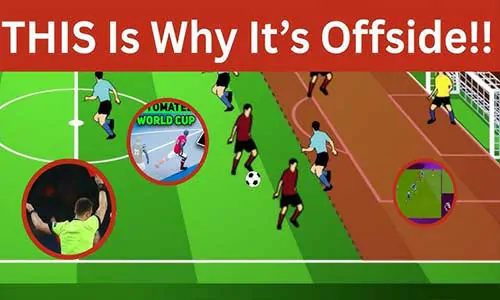
When an attacking player is closer to the opponent’s goal line than both the ball and the second-last defender at the exact moment the ball is played to them, they are in an offside position. If they receive the ball or influence the play from this position, the linesman raises their flag, and the defending team is awarded an indirect free kick. In the following sections of our Offside Rule Explained: A Beginner’s Guide to Football’s Most Confusing Law, we will explore these specific criteria in greater depth.
2. The Three Conditions of an Offside Position
To determine if a player is in an offside position, referees and assistant referees quickly evaluate three specific conditions. All three of these conditions must be met at the exact millisecond the ball is passed by a teammate, not when the player receives the ball.
Let us break down these three essential conditions in detail:
A. The Player is in the Opponent’s Half
A player can never be offside if they are in their own half of the field of play. The halfway line serves as a safe zone. Even if a striker is standing completely alone behind the entire opposing defense, they are perfectly onside as long as they remain on their side of the halfway line at the moment the pass is initiated.
B. The Player is Nearer to the Goal Line than the Ball
If an attacker is behind the line of the ball when it is passed, they are automatically onside. This is why you often see two players running toward an empty goal, where the player with the ball passes it sideways or backward to their teammate. Because the receiving player was behind the ball at the moment of the pass, no offside offence can occur.
C. The Player is Nearer to the Goal Line than the Second-Last Opponent
This is where most beginners get confused. The rule states that the attacker must have at least two opposing players between them and the goal line. Typically, the goalkeeper is the last opponent, meaning the “second-last opponent” is the last outfield defender. However, if the goalkeeper runs up the pitch during a corner kick, any defender remaining on the line becomes the last opponent, and another defender becomes the second-last opponent. Consequently, the position of the goalkeeper is not guaranteed to be the final barrier.
Furthermore, it is important to note which parts of the body are considered. According to the official IFAB Laws of the Game, any part of the player’s head, torso, or legs that can legally score a goal is taken into account. Hands and arms are completely excluded from this measurement because players cannot legally use them to play the ball.
3. Offside Rule Explained: A Beginner’s Guide to Football’s Most Confusing Law – Active vs. Passive Play
As previously mentioned, standing in an offside position is not an offence in itself. An assistant referee will only raise their flag if the player in that position becomes actively involved in the phase of play. This distinction is crucial for understanding modern football matches.
In our analysis of the Offside Rule Explained: A Beginner’s Guide to Football’s Most Confusing Law, we identify three distinct ways a player can transition from a passive offside position into an active offside offence:
- Interfering with Play: This occurs when a player touches or plays a pass delivered by a teammate. This is the most straightforward and common type of offside call.
- Interfering with an Opponent: A player can be penalized for offside without even touching the ball. If they block the goalkeeper’s line of sight, challenge a defender for the ball, or physically prevent an opponent from making a defensive play, they are deemed active.
- Gaining an Advantage: If the ball rebounds off the goalpost, crossbar, or is accidentally saved by a defender, and it lands at the feet of an attacker who was originally in an offside position, an offence is called. They gained an unfair advantage by being in that illegal position in the first place.
Conversely, if an attacker stands in an offside position on the left side of the pitch while their teammate scores a goal on the right side without any interference, the goal is completely valid. In this scenario, the player in the offside position is considered “passive” and has no impact on the outcome of the play.
4. Key Exceptions to the Offside Rule
To make the game more dynamic and prevent defensive teams from completely exploiting the rule, the creators of football established several notable exceptions. In these specific circumstances, a player can receive the ball in any position on the pitch without being penalized.
Understanding these exceptions will instantly elevate your knowledge of the sport. There are exactly three restarts in play where the offside rule is temporarily suspended:
A. The Throw-In
A player cannot be declared offside directly from a throw-in. Teams often use this exception to bypass a high defensive line by throwing the ball deep into the opponent’s corner to a striker standing behind the defenders. Because the restart is a throw-in, play continues naturally.
B. The Corner Kick
During a corner kick, the ball is placed on the boundary line at the very corner of the pitch. Because the ball is already on the opponent’s goal line, it is physically impossible for any attacking player to be closer to the goal line than the ball. Thus, offside is naturally impossible on the direct delivery of a corner.
C. The Goal Kick
Similar to the throw-in, if a goalkeeper kicks the ball directly from a goal kick, an attacking striker standing deep in the opponent’s territory can receive the ball without fear of being penalized. However, once another player touches the ball after the goal kick, the standard offside rules instantly apply again.
5. Tactical Impact: The Offside Trap Explained
The existence of Law 11 has dramatically shaped modern football tactics, particularly the defensive strategies employed by world-class managers. The most famous defensive tactic stemming from this rule is the “Offside Trap.”
The offside trap is a highly coordinated defensive maneuver where the entire backline of defenders steps forward in unison just before an opposing midfielder plays a forward pass. By rushing forward, they intentionally leave the attacking strikers standing behind them in an offside position. When the pass is made, the assistant referee has no choice but to flag the strikers offside.
However, this strategy carries immense risk. If even one defender fails to step up at the correct moment, or if a player reacts too slowly, the attacking striker will remain onside. As a result, the attacker gets a clear, unobstructed run toward the goal. Teams like Arrigo Sacchi’s AC Milan in the late 1980s mastered this art, whereas modern teams often use it selectively due to the high pace of contemporary attackers.
6. Modern Offside: The Role of VAR and Semi-Automated Technology
In recent years, the integration of technology has radically transformed how offsides are judged. Traditionally, human assistant referees had to track the exact moment a ball was kicked while simultaneously looking down the field to see the alignment of defenders and attackers. Unsurprisingly, human error was common.
In 2018, the introduction of the Video Assistant Referee (VAR) system altered this landscape. VAR allows a team of officials in a high-tech replay room to review offside decisions using calibrated computer lines. By freezing the broadcast frame at the exact moment of the pass, VAR can determine if a player’s shoulder or toe was millimeters ahead of the defender.
To further refine this process, governing bodies like FIFA introduced Semi-Automated Offside Technology (SAOT). This system utilizes specialized tracking cameras and microchips embedded inside the match ball to construct rapid 3D models of the players. Consequently, offside decisions are now made faster and with incredibly high precision, reducing long delays and enhancing the overall integrity of the sport.
7. History of Law 11: Why Does the Rule Exist?
To truly appreciate this law, we must look briefly at its historical evolution. The offside rule actually predates the official formation of association football itself, tracing its origins back to English public school games in the 19th century. Early versions of the rule were much stricter than they are today.
In the original 1863 rules of the Football Association, any attacking player positioned ahead of the ball was considered offside. This meant players could only pass the ball sideways or backward, much like rugby. In 1866, the rule was amended to allow forward passing, provided there were at least three opponents between the attacker and the goal line.
By 1925, the game had become defensively stale, leading to a major modification: the requirement of three opponents was reduced to two. This simple adjustment caused an immediate surge in goal-scoring across leagues worldwide. The modern clarification, which specifies that an attacker is onside if they are level with the second-last defender, was finalized in 1990 to give attackers a slight advantage and promote exciting, offensive football.
8. Summary Matrix of Common Offside Scenarios
To simplify your understanding, we have created a quick reference table outlining various in-game scenarios and how the referee will rule on them.
| Scenario | Attacker’s Position | Ruling | Reasoning |
|---|---|---|---|
| A striker receives a pass directly from a teammate’s throw-in. | Behind the last defender | Onside (Play Continues) | Offside rules do not apply directly from a throw-in. |
| A midfielder passes forward, and the striker is level with the last defender. | Perfectly aligned with defender | Onside (Play Continues) | To be offside, the attacker must be ahead of the defender’s scoring body parts. |
| An attacker stands offside, but the ball is passed backward by a defender. | Behind the defensive line | Onside (Play Continues) | The ball was played deliberately by an opponent, nullifying the offside. |
| A shot deflects off the post to an attacker who stood offside when the shot was taken. | Behind the last defender | Offside (Free Kick) | The attacker gained an advantage from being in an offside position. |
| An attacker is offside but does not touch the ball or block any opponent’s view. | Behind the last defender | Onside (Play Continues) | The player remained passive and did not interfere with active play. |
9. Frequently Asked Questions (FAQ)
Here are some of the most common questions beginners ask regarding the intricacies of the offside rule:
Can a player be offside in their own half of the pitch?
No, a player cannot be penalized for offside while standing in their own half of the field. They must cross the halfway line into the opponent’s territory for an offside position to be considered.
Does the goalkeeper count as one of the defensive players?
Yes, the goalkeeper is almost always the “last opponent,” which means the final outfield defender is the “second-last opponent.” However, if the goalkeeper moves forward, any two outfield players can fill those roles.
Can you be offside if you receive a pass that is played backward?
No, if the ball is passed backward or sideways, the receiver is behind the ball at the moment of the pass. Therefore, they do not meet the criteria of being closer to the goal line than the ball.
What is the penalty for committing an offside offence?
The defending team is awarded an indirect free kick from the exact spot where the offside player became actively involved in the play. This kick must be taken by a defending player to restart the game.
What does “passive offside” mean?
“Passive offside” refers to a situation where an attacking player is standing in an offside position but does not touch the ball, block an opponent’s movement, or interfere with the play. Consequently, the referee allows the game to continue.
Can a player be offside if they receive the ball directly from a corner kick?
No, there is no offside offence possible directly from a corner kick. Because the ball is already on the goal line, any receiving player is technically behind or level with the ball.
10. Conclusion and Final Thoughts
Mastering football’s most debated rule does not have to be an overwhelming challenge. With this Offside Rule Explained: A Beginner’s Guide to Football’s Most Confusing Law, you now possess the core knowledge needed to appreciate the tactical depth of the beautiful game. Remember, it all boils down to timing, positioning, and active involvement at the exact second the ball is kicked.
The next time you gather with friends to watch a match, look closely at the defensive line and the positioning of the strikers. You will likely spot the strategic battles unfolding in real-time, making your viewing experience far more engaging. If you found this breakdown helpful, feel free to share it with fellow fans, and leave a comment below sharing your thoughts on how VAR has affected the modern offside rule!